


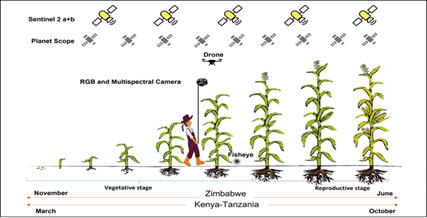
Low-cost image-based and other digital technologies will be introduced in the methodologies. These will include lecture seminars and practical training on stress phenotyping (relevant sensor technologies) and disease detection (relevant crops and prevalent diseases), on non-invasive imaging sensors (visible light RGB, thermal IR, Chlorophyll Fluorescence, Near Infra-Red, Multi and Hyper-spectral) and plant imaging at different levels (in vitro, chamber, greenhouse, field, satellite), hands-on training on image post-processing including tools like Morphoanalyser and ImageJ, data analysis, data management and many useful platforms (Phenomics Information system, PHIS, European Grid Infrastructure EGI, African Grid Infrastructure AGI). Lecture
seminars on Deep Learning approaches (Computer Vision training, public image collections for shared data and meta-analysis), and future perspectives such as airborne and satellite based vegetation, crop and disease monitoring, generating material (lectures slides and guidelines for field-based viral detection tools) and organisation of online lecture seminars on “field-based detection and identification methods in plant virology”, “field-based isothermal amplification”, “lateral-flow tests” and “Imaging based detection”. All these approaches represent a myriad of plant pathology detection advancements. Finally, the artificial
intelligence approaches will be employed to gain insight into the future of plant disease detection.
 VIRAL ERASMUS